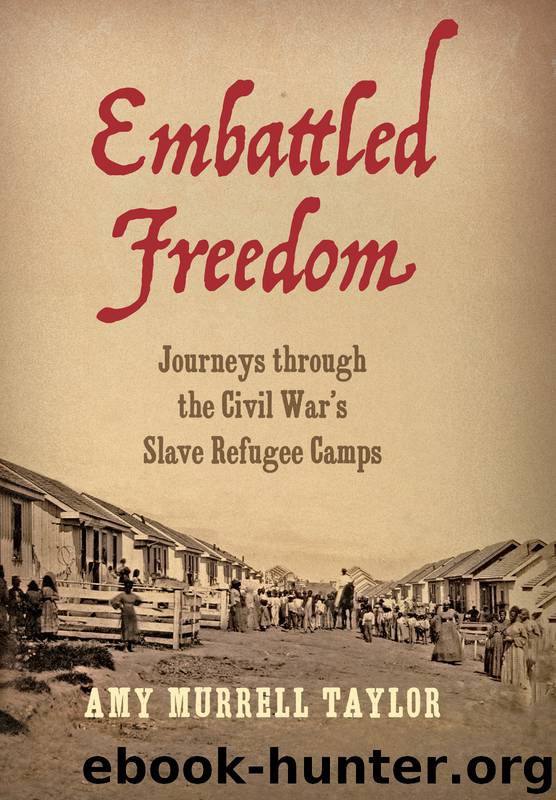
Embattled Freedom by Amy Murrell Taylor
Author:Amy Murrell Taylor
Language: eng
Format: epub
Publisher: University of North Carolina Press
Published: 2018-01-06T16:00:00+00:00
The most significant change came in March 1864. That month brought an abrupt end to impressment, as Union authorities, realizing that the military roads would not be completed in time for the Army of Ohio’s spring campaign, declared the practice “revoked” and the men “returned to their owners.”35 Gabriel Burdett, Robert Burdett, and many others did not immediately return to Garrard County, however, and one month later, in April 1864, came a near reversal. Union authorities decided not only that the army needed the men’s labor after all, but that it needed black men to labor as enlisted soldiers specifically. President Lincoln had just struck a deal with the state’s proslavery Union governor, Thomas Bramlette, promising to make sure the enlistments did not hurt Union slaveholding interests, by limiting recruitment only to men whose owners consented to the enlistment, paying those masters $300 in compensation, and sending any recruited men out of the state for training to spare white Kentuckians the sight of former slaves drilling in the uniform of the United States.36
It proved to be an untenable system. A wave of violence quickly followed across the state, as substantial numbers of owners objected, rather than consented, to enlistment. Yet enslaved men fled to enlist anyway, and military officials, unsure about whether or not their owners’ consent had been given, routinely defaulted to sending men back to their owners. Camp Nelson thus became “a hunting ground for fugitives,” observed the quartermaster, Capt. Theron E. Hall, who had a frontline view of the situation. “It has been an almost daily occurrence for some squad of men to be employed in hunting slaves and detaining them to their masters,” Hall wrote, and in many cases those captured were “tied together” like a “slave gang” and prodded along by armed soldiers.37 Other reports surfaced of owners severing the ears of men they retrieved with the army’s help or, in one case, of two men “fastened to trees in the woods and flayed alive.”38
The brutal violence pushed the Union’s hand. Not only did it threaten military order, but it also exposed the Union’s complicity in acts of inhumanity that, according to the laws of war, could not be ignored.39 Two months later, in June, the army dropped the requirement that owners must consent to a man’s enlistment. “All who present themselves for enlistment,” stipulated Adj. Gen. Lorenzo Thomas’s Special Order No. 20 on June 13, “will be received and enlisted into the service of the United States.”40 It did not matter how their owners felt about it—and those owners would no longer be compensated for their service. “The matter of their enlisting is optional with themselves,” one officer explained the new policy. “If they desire to enter the U.S. service they can do so—if they desire to remain at home and work for their masters they can do so.”41 As with all other Union soldiers, the men would be freed upon enlistment. This meant that the very first path had opened to legal emancipation for an enslaved person in the state of Kentucky.
Download
This site does not store any files on its server. We only index and link to content provided by other sites. Please contact the content providers to delete copyright contents if any and email us, we'll remove relevant links or contents immediately.
| Africa | Americas |
| Arctic & Antarctica | Asia |
| Australia & Oceania | Europe |
| Middle East | Russia |
| United States | World |
| Ancient Civilizations | Military |
| Historical Study & Educational Resources |
Cat's cradle by Kurt Vonnegut(15353)
Pimp by Iceberg Slim(14506)
4 3 2 1: A Novel by Paul Auster(12392)
Underground: A Human History of the Worlds Beneath Our Feet by Will Hunt(12097)
The Radium Girls by Kate Moore(12028)
Wiseguy by Nicholas Pileggi(5784)
The Fire Next Time by James Baldwin(5444)
Perfect Rhythm by Jae(5403)
American History Stories, Volume III (Yesterday's Classics) by Pratt Mara L(5307)
Paper Towns by Green John(5190)
Pale Blue Dot by Carl Sagan(5007)
A Higher Loyalty: Truth, Lies, and Leadership by James Comey(4962)
The Mayflower and the Pilgrims' New World by Nathaniel Philbrick(4502)
The Doomsday Machine by Daniel Ellsberg(4490)
Killers of the Flower Moon: The Osage Murders and the Birth of the FBI by David Grann(4447)
The Sympathizer by Viet Thanh Nguyen(4390)
Too Much and Not the Mood by Durga Chew-Bose(4348)
The Borden Murders by Sarah Miller(4325)
Sticky Fingers by Joe Hagan(4198)
